
UV-C lamps (also known by the name of: germicidal lamps) are low-pressure, mercury/rare gas discharge devices similar to fluorescent lamps. This is true in both operation and construction except for the lack of a phosphor coating on the inner lamp wall. A UV germicidal bulb converts electricity into ultraviolet radiation and the energy that is generated in the UV spectrum is used to destroy bacteria, fungi and viruses (microorganisms).
The features of a germicidal lamp include:
• The envelope has high transmittance for 254nm radiation
• Emits a significant portion of its radiative power in the UV-C Band (100 to 280nm)
• Some UV lamps produce UV energy of wavelengths shorter than 220nm that decomposes oxygen, O² , producing ozone, O³.
• A UV lamp that generates energy at 185nm which is particularly effective in producing ozone.
The lamp body may be made of pure fused quartz that will transmit both 254 and 185nm radiation (VH glass), quartz with Titanium added to block out most of the 185nm radiation (L glass), or of a “soft” glass formulated to transmit 254nm radiation (L glass).
UV Lamps generate energy in the UV spectrum to destroy bacteria, fungi and viruses (microorganisms). Microorganisms include several distinct groups of disease causing germs (Viruses, Bacteria, Fungi, Algae and Protozoa).
The target of UV disinfection is the genetic material, nucleic acid. As the UV penetrates through the cell and is absorbed by the nucleic acids, a rearrangement of the genetic information occurs, interfering with the cell's ability to reproduce. A cell that can not reproduce is considered dead; since it is unable to multiply to infectious numbers within a host.
The maximum absorption of UV light by the nucleic acid, DNA, occurs at a wavelength of 260nm. The germicidal lamp emitting UV at 254nm is operating very close to the optimized wavelength for maximum absorption by nucleic acids.
Low-Pressure Mercury Discharge
The most common form of germicidal lamp looks similar to an ordinary fluorescent lamp but the tube contains no fluorescent phosphor. In addition, rather than being made of ordinary borosilicate glass, the tube is made of fused quartz or soda-lime glass which allow the 185nm and/or 253.7 nm ultraviolet light produced by the mercury arc to pass out of the lamp unmodified. Germicidal lamps still produce a small amount of visible light due to other mercury radiation bands.
Medium Pressure Mercury Discharge
Medium-pressure lamps are more similar to HID (High Intensity Discharge) lamps than fluorescent lamps. These lamps radiate a broad-band UV-C radiation, rather than a single line. They are widely used in industrial water treatment, because they are very intense radiation sources. Medium-pressure lamps produces very bright bluish white light.
Standard Quartz Germicidal Lamps
High Output Germicidal Lamp Types
Amalgam Lamp Types
Glass type
Lamps are produced using three main glass types: Fused Quartz, Synthetic Fused Quartz and Soft Glass.
Fused Quartz “L” Type is doped with titanium to block 185nm transmission and is used for low ozone producing applications.
“VH” Type Fused (natural) Quartz is not doped and therefore transmits in both the 185nm and 254nm region and is used for very high ozone producing applications.
Synthetic Fused Quartz is used for very high ozone producing applications due to superior transmittance at 185nm but at significantly higher cost.
Soft Glass or soda-lime glass, Transmits in 254nm region only and needs lower cost to be produced.
Comparison of Quartz vs. Soft Glass
Fill Gas
All are essentially high vacuum lamps, filled to a very low pressure with one or more inert gases. The gas performs several key functions in lamp operation:
- Reduces the required starting voltage for the discharge, such that it can be easily struck on simple ballasts. Different gases have different effects - for instance with Argon the starting is very easy but with Krypton it is somewhat more difficult.
- It acts as a buffer gas to protect the electrodes, reducing the impact of ions which bombard them during the anode phase, and thereby reducing erosion of the electrode by sputtering and evaporation. This greatly extends lamp life, the gases of higher molecular weight offering the greatest degree of protection of the electrodes.
- It is adjusted to provide the right balance between rate of ionization of mercury atoms (required to maintain the current flow through the lamp) and the excitation of mercury atoms so as to optimize the UV generation efficiency.
- Its presence randomizes the direction of motion of free electrons in the discharge to control their mean free path length and velocity.
- Depending on the lamp design and its intended application, the gas employed may be Argon, Neon or Xenon and/or a mixture of at least two of these components.
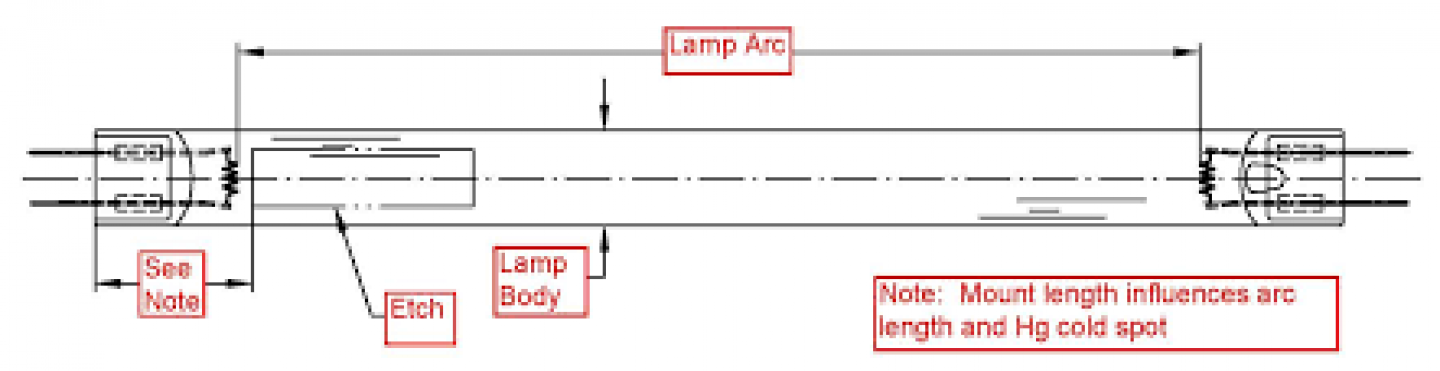
Filament Mount Sub-Assembly
Lead Wires Provide electrical connection from ballast leads to lamp filament.
Lamp Filament (Coil):
- Standard = Nominal 425mA
- High Output = Nominal 600 - 800mA
- Amalgam Lamp = Nominal 1.0 – 5.0 A
UV lamps work best when they functioning continuously. Normal operation requires that the UV lamp to be turned on and off, on average, once a day.
Standard low pressure UV lamps have a normal lifespan of between 8,000 and 10,000 hours.
High Output and Amalgam low pressure UV lamps have a normal lifespan of 10,000 to 14,000 hours.
Medium pressure UV lamps have a normal lifespan of 4,000 to 8,000 hours.
If the number of on / off cycles increases, the lamp life can be halved. It is very important that UV lamps are replaced during their guaranteed life, in this way an optimal operation of the UV system is ensured.
Standard Lamps: Applications where flow rates are lower, and exposure time can be longer.
HO Lamps: Applications where higher flow rates or dosages are required while maintaining a limited footprint
Amalgam Lamps: Applications where very high output is required and/or ambient temperature is an issue.
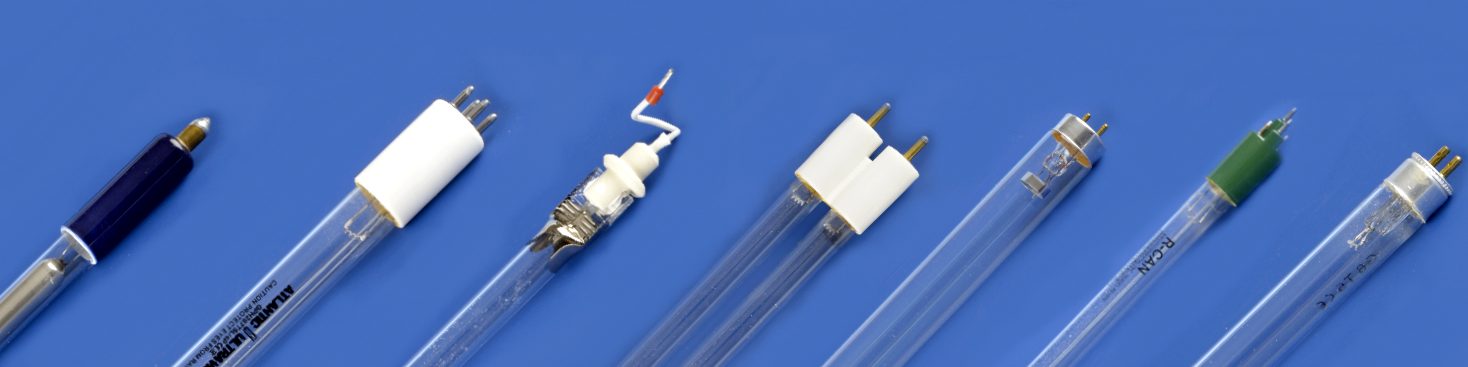
A variery of lamps can be found here. Feel free to contact us for any information while you look for lamps or accessories. We will find a suitable lamp for your UV system in the shortest time.
Source:
LightSources