
When giving a solution, we make sure that all the three key parameters like UV Dose, Flow rate and UV Transmittance (UVT) are known. This way we can assure our customers that they will receive a UV system that actually performs as per their needs.
While UV dose and Flow rate are easy to understand, experience shows that most of the customers do not know what UV transmittance is and how important it is when sizing an UV system.
UV Transmittance (UVT) is the amount of UV light passing through the water and it's measured in percentage.
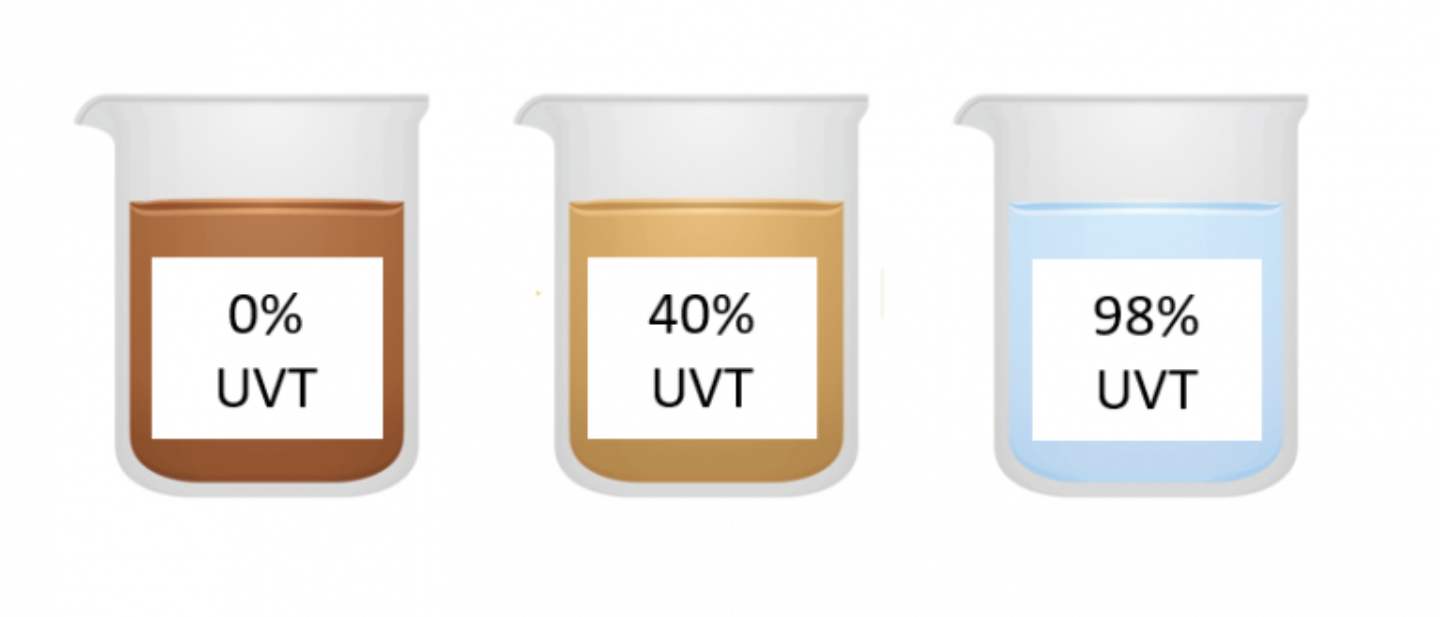
UVT is the most important water quality parameter for designing a UV facility and influences both UV equipment capital and operating costs. Overly conservative design UVT values can result in the need for additional equipment and larger reactors while inappropriately high UVT design values can violate permit levels by creating insufficiently disinfected water.
The UVT has big impact on the performance of UV system, that is why it is a critical parameter when sizing a system. If you have lower UVT than originally sized, then the delivered intensity will be lower and respectively the disinfection won’t be efficient.
The amount of UV light at 254nm to pass through a defined path length of sample water compared with the same path length with Distilled water. Standard path lengths 10mm.

Here you can see some Typical UVT values for different type of water:
| Type of water | Typical UV transmittance (1 cm) @ 254 nm |
| Ultrapure water | ≥ 98% |
| Drinking water | 70 – 96% |
| Swimming pool water | approx. 94% |
| Sea water | 70 – 90% |
| Tertiary treated effluent | 60 – 70% |
| Secondary treated effluent | 45 – 60% |
| Primary treated effluent | 20 – 45% |
The value of accurately measuring UV Transmittance (UVT) when sizing a new UV disinfection system cannot be underestimated. Using an accurate UVT value during the sizing and operation of new UV equipment can have a direct impact on both energy consumption and achieving the desired disinfection performance.
However, many customers that are considering new treatment equipment either don’t have access to the proper instrumentation or simply aren’t aware of the various options available to them for measuring the UVT of their water or fluid.
There are several ways that customers can measure the UV Transmittance of their water or other fluid (such as sucrose or brine) to enable them to provide this information to the UV manufacturer who can then make suitable recommendations on correct UV sizing:
1) Send a sample of the water or fluid to a local laboratory
Customers can send a small volume of fluid to a local lab to have the transmittance of any fluid measured. Most labs will charge a fee for this service, depending on which parameters they are capable of measuring. The benefit of using the services of a lab to determine the UVT is that other important parameters that are relevant to the operation of a UV system can be measured at the same time. These include the concentration of iron, manganese, total suspended solids (TSS), turbidity (NTU) and total organic carbon (TOC).
2) Send a sample of the water or fluid to the UV manufacturer
Reputable UV manufacturers will also have the capability to measure the transmittance of fluids at their facilities. Samples can be sent directly to the manufacturer, who will test the fluid in house and often be able to provide with quicker results than a third-party lab.
3) Using a portable UVT instrument directly in the field
There are a few instruments available on the market for measuring UVT directly in the field. Because there is no need to send a sample away for testing, this can save both time and money. These instruments are handheld, portable devices that can accurately measure the transmittance of any fluid by collecting a small sample and testing it immediately at a customer’s site.
Portable UVT instruments can be purchased from an instrumentation company or borrowed from a local distributor, who often have devices available for customer use. This method of testing can save a considerable amount of time and produce an almost instant result.
4) Generate a historical UVT trend report using a continuous transmittance analyzer
For applications where the water quality can fluctuate seasonally or from batch to batch in an industrial process, it could be beneficial to install a continuous UVT analyzer a number of months prior to the purchase of a UV disinfection system. A UVT analyzer trending report available in advance of equipment purchase will help to understand the minimum and maximum UVT levels, rather than looking at the result of a one-off sample.
This is particularly important for treatment applications with significant flow rates, where the investment in UV disinfection equipment could be hundreds of thousands of euros.
Regardless of the UVT testing method chosen, providing actual UVT test results will provide the UV manufacturer with a true understanding of water quality helping them correctly size the new UV system.
If you need help with choosing UV system, write us at contact@spectra.ro and we will respond in no time.
Source:
Hanovia